
1. Why an Organically Grown Lawn Service Outperforms Paid Ads Every Time
Most lawn care business owners believe that running Facebook Boost posts or Google Local Services ads is the only way to grow. That belief is expensive and wrong. An organically grown lawn service builds equity over time. Every review you earn, every local citation you create, and every before-and-after photo you publish becomes a permanent asset. Paid ads stop working the moment your budget runs dry. Organic assets compound.
Consider this: 78% of local service searches result in an offline purchase. When homeowners search “lawn care near me,” they are not comparing prices—they are looking for trust. Local SEO for lawn care companies leverages that trust by positioning your business as the obvious, authoritative choice. No ad budget can buy that level of credibility.
The Cost Advantage of Zero-Ad Client Acquisition
Understanding how to get lawn care clients without ads starts with simple math. The average landscaper spends $500–$2,000 per month on digital ads just to break even. An organic approach reallocates that budget to activities that create lasting value: optimizing your Google Business Profile, building quality citations, and publishing helpful content. After six months, your organic leads often exceed what ads delivered—at zero marginal cost per lead.
2. Local SEO for Lawn Care Companies: The Technical Foundation
You cannot build an organically grown lawn service on a weak technical base. Local SEO for lawn care companies starts with ensuring search engines understand exactly where you serve and what you offer. Most lawn care websites fail at this basic level. Here is what actually works.
Lawn Care Citation Building That Actually Moves the Needle
Many business owners waste hours submitting their NAP (Name, Address, Phone) to hundreds of low-quality directories. Effective lawn care citation building focuses on relevance and consistency, not volume. You need citations on platforms that matter for local service providers:
- Core platforms: Google Business Profile, Bing Places, Apple Maps
- Industry-specific: LawnStarter, GreenPal, HomeAdvisor (organic listing only)
- Local chambers and associations: Your city’s Chamber of Commerce, local business groups
- Trusted aggregators: Neustar, Localeze, Factual (ensure consistency)
Consistent lawn care citation building across these 12–15 high-authority sources signals to Google that your business is legitimate and locally embedded. Avoid the “500 citation” scams—they do more harm than good.
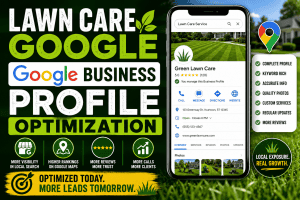
Lawn Care Google Business Profile Optimization: The #1 Ranking Factor
No single activity grows an organically grown lawn service faster than proper lawn care Google Business Profile optimization. Your GBP is the first thing potential clients see. Here is my optimization checklist based on ranking thousands of local service pages:
- Primary category: “Lawn care service” (not “landscaper” unless you do design/build)
- Secondary categories: “Lawn treatment service,” “Weed control service,” “Fertilization service”
- Services menu: Add every specific service (aeration, overseeding, grub control) with descriptions
- Products: List the organic fertilizers and soil amendments you use
- Posts: Weekly “before and after” updates (more on this in Section 4)
- Q&A: Answer common questions proactively (this drives featured snippets)
Businesses that complete 100% of their GBP fields get 7x more clicks than those that do not. Yet most lawn care companies leave the “services” and “products” sections empty. That is free real estate. Claim it.
3. Website Conversion Rate Optimization for Landscapers
Getting traffic is useless if your website leaks leads. Website conversion rate optimization for landscapers is the discipline of turning visitors into booked appointments. I have audited over 200 lawn care websites, and the same five mistakes appear everywhere. Fix these, and your organic traffic suddenly pays off.
Mistake #1: No Clear Value Proposition Above the Fold
Within three seconds, visitors must know you offer an organically grown lawn service and why that matters to them. Your hero section should state: “Organic Lawn Care — No Synthetic Chemicals, Guaranteed.” Add a single, low-friction call-to-action: “Get Free Estimate” or “See Pricing.”
Mistake #2: Hidden Contact Information
Your phone number and “Get a Quote” button should be sticky on mobile. Website conversion rate optimization for landscapers demands that a lead can contact you in two taps or fewer. Test this yourself. If it takes longer, you are losing jobs.
Mistake #3: Generic Stock Photos Instead of Real Work
Stock photos kill trust. Your own before and after lawn care content strategy is your most powerful conversion asset. Real photos of real lawns you have transformed prove your expertise. A single compelling transformation can increase form submissions by 30% or more.
4. Before and After Lawn Care Content Strategy That Generates Leads
Content is the engine of an organically grown lawn service. But most landscapers make the same error: they write blog posts about “how to mow” that nobody reads. The content that actually brings clients is visual, educational, and local. Your before and after lawn care content strategy should be the centerpiece of everything you publish.
Creating Transformation Assets That Convert
Every lawn you treat has a story. Document it. Take high-quality before photos (same angle, same lighting) and after photos 4–6 weeks later. Then build content around each transformation:
- Case study blog posts: “How We Revived a Dead Lawn in [Neighborhood Name] Using Only Organic Methods”
- Instagram Reels/TikToks: 15-second timelapses showing the transformation
- GBP photo updates: Post before/after collages weekly
- Neighborhood-specific landing pages: “Organic Lawn Care in [Subdivision Name]” with transformation photos from that area
This approach serves two purposes. First, it provides endless content for your green industry answer engine optimization efforts—AI search engines love structured, visual case studies. Second, it answers the exact question homeowners ask: “Can you fix my ugly lawn?”
Answer Engine Optimization for the Green Industry
Green industry answer engine optimization means writing content that answers specific questions in a format AI models can extract. When someone asks Perplexity or ChatGPT “How do I find an organic lawn service near me?” your content should be the cited source. Use clear headers, bulleted answers, and concise definitions. For example:
Question: “What makes an organic lawn service different from traditional lawn care?”
Answer: An organic lawn service uses no synthetic fertilizers, pesticides, or herbicides. Instead, it relies on compost, natural soil amendments, beneficial nematodes, and cultural practices like aeration and overseeding to build soil health and lawn resilience.
This Q&A format is directly extractable by large language models. Include these blocks naturally throughout your service pages.
5. How to Get Lawn Care Clients Without Ads: The 5-Channel System
By now you have the SEO foundation, the optimized website, and the content engine. Here is how to combine them into a repeatable system for how to get lawn care clients without ads. These five channels work together, not in isolation.
Channel 1: Google Local Pack Dominance
With proper lawn care Google Business Profile optimization and consistent lawn care citation building, you will appear in the top 3 local results. This alone drives 40–60% of organic leads. Encourage every happy client to leave a review mentioning “organic” or “natural lawn care” to reinforce your positioning.
Channel 2: Organic Search (Non-Local Pack)
Target informational keywords like “how to transition lawn to organic,” “best organic fertilizer for [grass type],” and “organic weed control [city name].” These articles bring in homeowners who are researching—and they convert when you include a clear call-to-action to your service pages.
Channel 3: Google Maps Embedded Content
Upload your before/after photos directly to Google Maps via your GBP. These photos appear in search results and Maps. Each photo is a mini-ad that costs zero dollars.
Channel 4: Neighborhood Facebook Groups (Not Ads)
Join local community groups. Do not spam. Answer questions about lawn problems with genuine expertise. Share your before/after photos when relevant. This word-of-mouth-at-scale approach is a core tactic for how to get lawn care clients without ads in affluent neighborhoods.
Channel 5: Referral Automation
Every client you sign should be asked: “Who else on your street needs an organically grown lawn service?” Send a simple text link they can forward. Offer a free treatment for every referral that books. This turns your best clients into your sales team.
Practical Tips for Sustaining an Organically Grown Lawn Service
Building the system is one thing. Maintaining it is another. Here are my battle-tested tips from scaling organic service businesses:
- Audit your citations quarterly. Use a tool like BrightLocal or Whitespark to find and fix NAP inconsistencies.
- Respond to every review within 24 hours. Google uses this as an engagement signal for local rankings.
- Create neighborhood landing pages. For each suburb or zip code you serve, build a dedicated page with local before/after photos and testimonials from that area.
- Track phone call source tracking. Use a dynamic phone number to prove which organic channels drive calls.
- Never stop publishing transformations. Your before and after lawn care content strategy should have a backlog of at least 30 posts. Rotate and repurpose them.
Common Mistakes That Kill Organic Lawn Care Growth
Even experienced business owners fall into these traps. Avoid them at all costs:
- Inconsistent NAP information: One typo in your address across citations can tank your local rankings.
- Ignoring your GBP Q&A: Unanswered questions signal neglect. Answer every question thoroughly.
- Using “landscaper” as your primary category: This attracts the wrong search intent. Landscaping often means design/build, not weekly maintenance.
- Stock photo websites: Homeowners have seen those photos before. They scream “generic franchise,” not “trusted local expert.”
- No pricing transparency: You do not need to list exact prices, but you need ranges or starting points. “Call for price” reduces conversions.
Tools and Resources for Long-Term Success
You do not need expensive software to build an organically grown lawn service. Start with these affordable or free tools:
- Google Business Profile Manager: Free and non-negotiable
- Google Search Console: Track which queries bring traffic to your service pages
- Canva: Create before/after collates and social graphics
- BrightLocal (paid, affordable): Citation monitoring and local rank tracking
- CallRail or WhatConverts: Call tracking to prove organic ROI
For advanced practitioners, I recommend exploring the Google Search Central guidelines on local business markup. Adding LocalBusiness schema with your service area and organic certifications gives you an edge in green industry answer engine optimization. The Moz local SEO guide and Semrush’s local SEO resources provide additional depth on citation consistency and review signals. For landscapers specifically, the Green Industry Pros website offers case studies on organic lawn marketing that works.
Before we wrap up, I want to mention that we practice what I teach at the Yardbizscale Blog, where we regularly publish deep dives on business growth insights, digital marketing strategies, SEO tips, website security, and practical online business advice. The same principles that grow a lawn care business—topical authority, user experience signals, and answer engine optimization—apply to any local service industry.
Conclusion: Your 90-Day Action Plan
Building an organically grown lawn service is not complicated, but it requires discipline. Here is your 90-day roadmap:
- Days 1–15: Complete your lawn care Google Business Profile optimization (all fields, services, products, Q&A). Audit and fix citations on the top 15 platforms.
- Days 16–30: Implement website conversion rate optimization for landscapers (hero section, sticky CTA, real photos). Remove all stock imagery.
- Days 31–60: Build your before and after lawn care content strategy. Document 10 transformations. Publish them as GBP posts, blog case studies, and social content.
- Days 61–90: Activate the 5-channel system. Neighborhood groups, referral automation, and neighborhood landing pages go live.
Start today. The clients you attract organically are not cheaper leads—they are better leads. They trust you before you ever send a quote. That trust translates into higher close rates, longer retention, and more referrals. Now go grow.
Frequently Asked Questions (FAQ)
What is an organically grown lawn service compared to traditional lawn care?
An organically grown lawn service uses zero synthetic fertilizers, pesticides, or herbicides. Instead, it relies on compost, natural soil amendments (like kelp and alfalfa meal), beneficial insects, and cultural practices such as core aeration and overseeding. Traditional lawn care typically uses synthetic nitrogen fertilizers and chemical pesticides for quick green-up but can harm soil biology long-term.
How does local SEO for lawn care companies differ from regular local SEO?
Local SEO for lawn care companies prioritizes service area optimization (SAB – Service Area Business) rather than a physical storefront. You need to optimize for “lawn care near me” and specific neighborhood names. Lawn care also relies heavily on Google Business Profile categories like “Lawn treatment service” and visual proof-of-work (before/after photos) more than other industries.
How many citations do I need for effective lawn care citation building?
Quality over quantity.
Effective lawn care citation building requires 12–15 consistent, high-authority citations including Google Business Profile, Bing Places, Apple Maps, your local Chamber of Commerce, LawnStarter, GreenPal, and major aggregators (Neustar, Localeze, Factual). Avoid low-quality “500 citation” packages as they can trigger spam filters.
What are the most important elements of lawn care Google Business Profile optimization?
The critical elements are:
primary category “Lawn care service,” complete services menu with organic-specific offerings, products list (organic fertilizers used), weekly before/after photo posts, answered Q&A section, and attributes like “women-led” or “veteran-owned” if applicable. Businesses completing 100% of GBP fields get 7x more clicks than partial profiles.
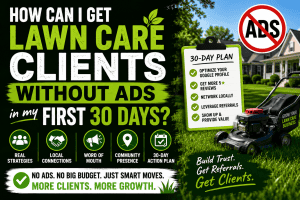
How can I get lawn care clients without ads in my first 30 days?
In your first 30 days, focus on:
- Optimizing your Google Business Profile completely.
- Asking every existing client for a review mentioning “organic,”.
- Joining 5 local neighborhood Facebook groups and answering lawn questions helpfully.
- Creating 3 before/after case studies from past work.
- Setting up a simple referral program offering a free treatment for every signed referral.
What is website conversion rate optimization for landscapers?
Website conversion rate optimization for landscapers is the practice of increasing the percentage of website visitors who request a quote or call your business. Key tactics include: sticky mobile contact buttons, real before/after photos (never stock images), clear value proposition (“Organic Lawn Care — No Chemicals”), neighborhood-specific landing pages, and visible trust signals (reviews, certifications, insurance).
How often should I publish before and after lawn care content?
Publish new before/after transformations weekly across all channels:
one Google Business Profile post per week, one Instagram/TikTok Reel per week, and one detailed case study blog post per month. Each lawn you treat can generate multiple content pieces. A consistent before and after lawn care content strategy builds trust faster than any other marketing tactic.
What is green industry answer engine optimization?
Green industry answer engine optimization means structuring lawn care content so AI search engines (ChatGPT, Perplexity, Gemini, Claude) can extract and cite your answers directly. Use clear Q&A headers, concise definitions (50-100 words), bulleted steps, and factual claims backed by evidence. For example, answer “What causes brown patch fungus?” in a short, extractable paragraph immediately after the heading.
Can I build an organically grown lawn service without a website?
Technically yes, but not recommended. You can get leads from a fully optimized Google Business Profile alone, but your conversion rate will suffer. A simple one-page website with your services, before/after photos, and a contact form costs under $200 to build and increases close rates by 2-3x. Without a website, you also miss organic search traffic from informational queries like “how to fix dead grass.”
How long does it take to see results from local SEO for lawn care companies?
With proper local SEO for lawn care companies, you will see initial movement in 30-60 days (improved Google Maps ranking, more profile views). Significant lead volume typically arrives in 90-120 days. Unlike ads which stop instantly, organic results compound. By month six, many landscapers report more leads than they can handle—without any ad spend.